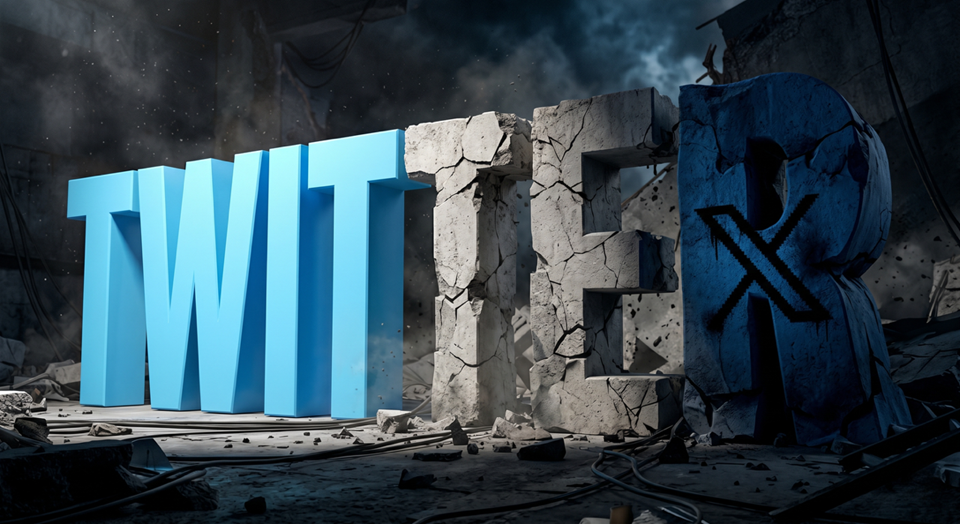
 I am exceptionally pleased to announce the release of the 'twitter' issue of M/C Journal, which I co-edited with Alfred Hermida. This celebrates / commiserates / memorialises / laments the 20th anniversary of what used to be Twitter.
To help in that task, we've brought together a fantastic group of long-standing Twitter and social media researchers, including (deep breath) Elizabeth Dubois, Leysia Palen, Timothy Graham, Marisa Duarte, Marco Bastos, Christoph Neuberger, Fabio Giglietto, Cornelius Puschmann, Katrin Weller, Yining Wang, Yannik Peters, Johannes B. Gruber, Breigha Adeyemo, Zizi Papacharissi, and Tanja Bosch. We're deeply grateful for their reflections on Twitter's legacy and the future of social media.
I open the issue by tracing the history of the platform from its initial Oprah-endorsed breakthrough to its decline under Elon Musk. What lessons can we learn both from Twitter’s initial successes and X’s ultimate failure? Is the solution really just to create yet another Twitter clone?
Alfred Hermida then revisits his concept of “ambient journalism”, as Twitter in its heyday enabled ordinary users as well as professional journalists to monitor a global ambient information feed. Present-day X no longer functions in this way, but produces a new kind of synthetic ambience.
Elizabeth Dubois examines the rise and fall of Twitter as a tool especially for political journalism. The fragmentation of political coverage and public debate, and the rise of newsfluencers and other nontraditional actors, raise significant concerns for democratic communication.
Leysia Palen reflects on the trajectory of disaster responders on the platform. Her article traces how crisis communication on Twitter has evolved over time. Nothing has filled the gap in the crisis communication infrastructure created by the decline of Twitter.
Timothy Graham positions Twitter as “epistemic infrastructure”. But Twitter left itself wide open to disinformation and influence operations. The consequences of these choices point to the architectural challenges that new platforms seeking to replace Twitter must now face.
Marisa Duarte and Marco Bastos show X under Elon Musk as firmly interwoven with open source intelligence and state surveillance tools as provided by Palantir, Babel Street, and other deeply problematic actors with an anti-democratic and techno-utopian mindset.
Christoph Neuberger highlights the precarity of a European public sphere dependent on Silicon Valley platforms. Its development and that of platforms that would support it must go hand in hand. Neuberger sketches out a path towards a European media platform that is oriented towards the common good.
Fabio Giglietto and Cornelius Puschmann discuss new requirements for public-interest research data access, such as those implemented under the EU’s Digital Services Act, and alternative modes of gathering data about platform activities that involve rather than merely observe users.
Katrin Weller and colleagues explore the longstanding and unresolved challenges of preserving the history of Twitter, and Twitter as a source of historical data. We must preserve the scattered archives that do exist and learn our lessons for the preservation of future social media platforms.
Breigha Adeyemo and Zizi Papacharissi introduce the concept of unbecoming. Twitter has now unbecome, following its conversion into X; X itself is unbecoming of a public communications infrastructure in a democratic society. Current logics of permanent growth and value extraction must be undone.
We conclude, quite appropriately, with an obituary. Tanja Bosch reflects on Twitter's role in the forming prosocial and activist digital publics and the gap that Twitter’s demise leaves. Fragility is a constitutive condition of contemporary digital publics: how can publicness be sustained, then?
Issue 29.2 of M/C Journal, 'twitter', is now live and free on the M/C Journal site. We hope you enjoy reading it as much as we did creating it.